
Sculptra or Hyperdilute Radiesse?
An Evidence-Based Guide to Choosing the Right Biostimulator

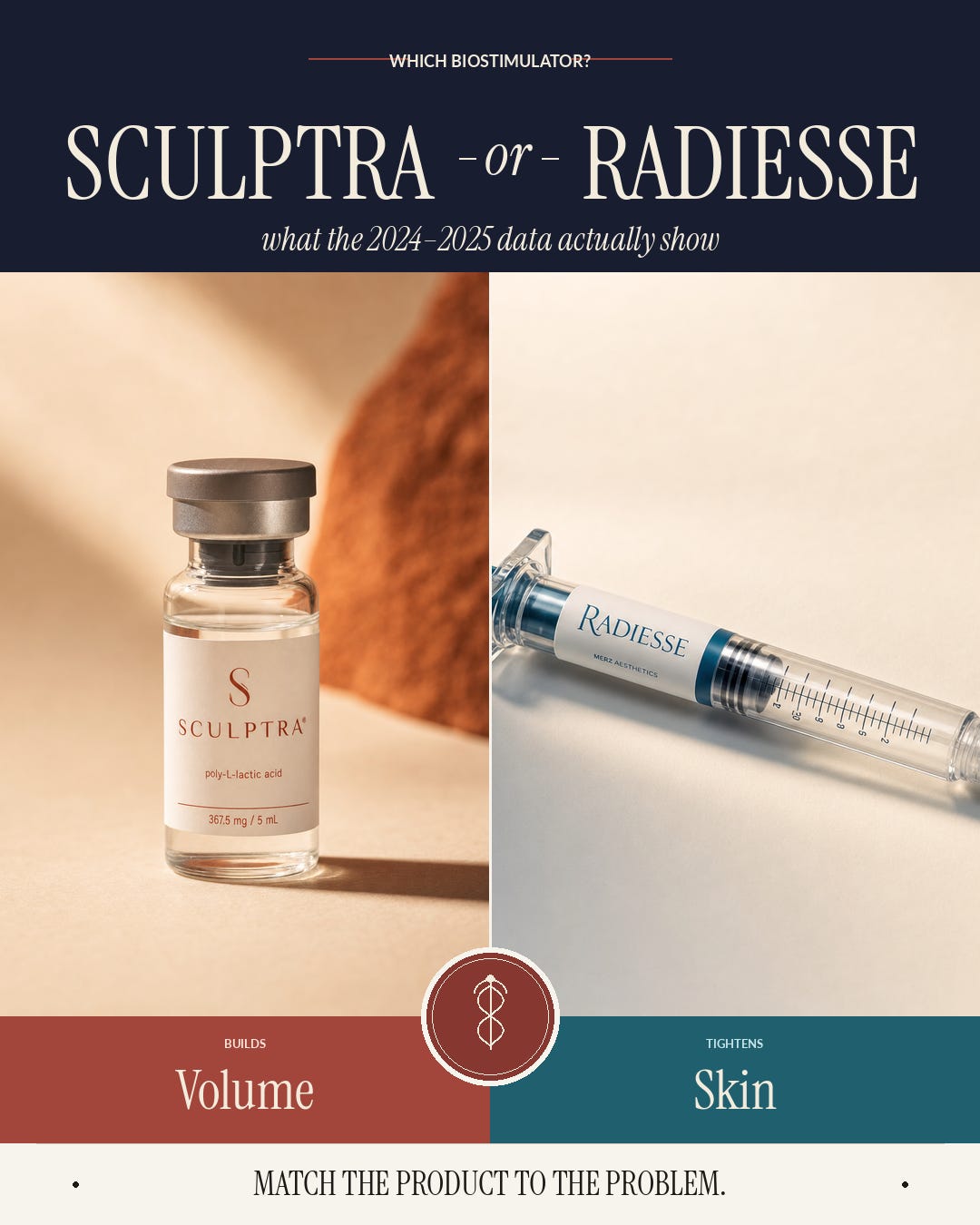
The two most-used collagen biostimulators in aesthetic medicine are often pitched as interchangeable. They aren’t. Here is how I think about choosing between them — and what the data actually show.
Walk into ten medspas and ask which biostimulator is “best,” and you’ll get ten different answers — usually whichever one the practice happens to stock. That isn’t a clinical decision; it’s inventory management.
Sculptra (injectable poly-L-lactic acid, PLLA) and hyperdilute Radiesse (calcium hydroxylapatite-carboxymethylcellulose, CaHA-CMC, typically diluted 1:2 to 1:4) are both excellent products. But they do meaningfully different things at the tissue level, and matching the right product to the right patient is what separates a satisfying result from a disappointing one.
Here is the framework I use, grounded in the published evidence.
What each product actually does
Sculptra is a synthetic, biodegradable polymer supplied as a lyophilized powder and reconstituted with sterile water (most commonly 8–9 mL per vial for the face). It provides essentially no immediate volume. Over weeks to months, the PLLA microparticles trigger a controlled foreign-body response that activates fibroblasts and lays down type I and type III collagen. Recent mechanistic work also shows PLLA stimulates adipogenesis in subcutaneous fat via the NRF2/PPARγ/C/EBPα pathway, increasing adipocyte number (hyperplasia) without hypertrophy (Oh et al., Polymers, 2025). A split-body randomized trial of the hip dip confirmed a 27% increase in the subcutaneous adipose layer at 9 months on the PLLA-treated side (Wesley et al., Dermatologic Surgery).
Hyperdilute Radiesse is the same CaHA-CMC product used for traditional volumization, but mixed with saline and lidocaine at a 1:2 to 1:4 ratio. The dilution serves two purposes: it disperses the CMC gel (eliminating the immediate volumizing effect) and spreads the microspheres over a larger surface area for biostimulation. The microspheres then drive neocollagenesis, elastogenesis, and angiogenesis. Notably, CaHA’s elastin induction is roughly 3.5× greater than PLLA’s in head-to-head histology (Modern Aesthetics, 2025).
The key difference:
Sculptra primarily builds volume.
Hyperdilute Radiesse primarily tightens skin.
Both build collagen, but the downstream clinical effect is not the same.
What the volumetric data actually shows
If your goal is to add real, measurable volume to the face, Sculptra wins — and not by a small margin.
In Fabi et al.’s 2024 randomized controlled trial (n=67), 3D imaging showed PLLA produced midface volume gains of +4.88 mL on the left and +2.84 mL on the right at 9 months compared with no-treatment controls (summarized in PRS Global Open, 2025). A 2-year retrospective 3D imaging study (n=28) found 0.75 to 6.4 mL of soft-tissue formation per vial of PLLA, still present two years out (Goldie et al., Clin Cosmet Investig Dermatol, 2025).
Hyperdilute Radiesse produces volume gains too, but smaller. Cartier and colleagues used QuantifiCare 3D Track on 22 patients receiving 1:3 hyperdilute CaHA-CMC and found cheek volume increased significantly at Day 150 (+32.9% left, +15.1% right) along with 40.8% reduction in jowl volume, 27.9% reduction in nasolabial fold depth, and 26.9% reduction in marionette line depth (ASJ Open Forum, 2025).
Notice the pattern: modest cheek gain, substantial reduction in laxity-driven contour deformities. That is hyperdilute Radiesse’s signature.
Durability also favors Sculptra. A 2025 systematic review of 14 studies concluded PLLA’s effects persist for up to 25 months, while CaHA results last 12 to 18 months (PMID 41184662).
When I reach for Sculptra
Diffuse, age-related volume loss across the midface and lower face. This is Sculptra’s home turf. The patient in her late 40s to 60s who looks hollow rather than lax — flattened cheeks, deepening tear troughs, prejowl atrophy, temporal hollowing — does better with PLLA than with hyperdilute CaHA. The Fabi trial enrolled exactly this phenotype and showed durable, measurable midface restoration.
Post-GLP-1 weight loss with significant facial atrophy. Patients who have lost meaningful weight on semaglutide or tirzepatide often present with global volume deficit, not just laxity. Sculptra’s combined neocollagenesis and emerging adipogenic effect addresses both compartments. (Hyperdilute Radiesse has a small case series in this population too — it preserved cheek volume despite ~9% weight loss — but only n=4, and PLLA’s mechanism is more biologically aligned with restoring lost fat.)
Patients who want maximum longevity and don’t mind delayed gratification. Sculptra demands patience. Results emerge over 3–6 months and peak around 6 months after the final session, typically requiring 2–4 sessions spaced 4–6 weeks apart. Counsel the impatient patient accordingly.
HIV-associated facial lipoatrophy. Still the original FDA indication, and the mechanism (true volume restoration via collagen and possibly adipocyte regeneration) matches the pathology.
Body areas with diffuse volume loss — buttocks, hips, thighs, upper arms. Sculptra’s spread, dilution flexibility, and durability are well-suited here.
When I reach for hyperdilute Radiesse
Skin laxity and crepiness without significant volume deficit. The patient whose problem is loose skin — the jawline that has softened but the cheeks are still full, the lower face that is sagging rather than hollow, the crepey décolleté — is a better candidate for hyperdilute CaHA. The 1:3 to 1:4 protocols are designed for exactly this presentation.
Neck, décolleté, and arms. These areas need spread, biostimulation, and skin tightening, not bulk volume. Hyperdilute Radiesse at 1:2 (FDA-cleared for décolleté wrinkles) or 1:4 (neck and arms) is the workhorse here. The 1:4 neck protocol increased dermal thickness by 15% and improved laxity in 82% of patients in Lorenc et al.’s ultrasonographic study (Clin Cosmet Investig Dermatol, 2023).
Patients who want a faster timeline. Hyperdilute Radiesse typically requires 2 sessions 4 weeks apart, with peak effect at 5–6 months. The total commitment is shorter than Sculptra’s.
Jowl, nasolabial fold, and marionette line softening through contour repositioning rather than direct filling. Cartier’s data are compelling here: substantial reductions in those three contour metrics without lumpy volumization.
The patient who is already volumized but losing definition. When the architecture is preserved but the skin envelope is loose, hyperdilute CaHA tightens without adding the unwanted fullness that more PLLA could produce.
Safety considerations that should influence the choice
Nodule risk. Sculptra has a higher published nodule rate (historically up to 6.8% with older protocols, lower with modern 8–9 mL reconstitution and 24+ hour hydration). Hyperdilute Radiesse has a lower nodule rate when injected correctly in the subdermal plane, but visible product or beading can occur in thin skin if dilution is inadequate.
Reversibility. Neither is reversible. Hyaluronidase doesn’t touch them. Sculptra nodules typically resolve over months; CaHA nodules can be more persistent and occasionally require steroid injection or excision.
Skin of color. Both are reasonable choices. CaHA’s whitish color can occasionally be visible if placed too superficially, which is one reason higher dilutions (1:3, 1:4) are preferred in thinner or darker skin per the Pan-Asian consensus.
Avoid in lips. Both products are contraindicated in the lips due to high nodule rates.
A practical algorithm
Ask yourself three questions in this order:
What is the dominant problem: hollowness or laxity?
Hollowness → Sculptra
Laxity → hyperdilute Radiesse
Both → Sculptra first for the deep volume, then hyperdilute Radiesse for the surface tightening, ideally separated by 4–6 weeks
What is the anatomic location?
Midface, prejowl, temples, body volume restoration → Sculptra
Neck, décolleté, jawline contour, crepey skin anywhere → hyperdilute Radiesse
3. What is the patient’s timeline and tolerance for sessions?
Wants the longest-lasting result and accepts a 6-month timeline → Sculptra
Wants visible improvement in 2–3 months with fewer sessions → hyperdilute Radiesse
Combining Sculptra and HDR
These are not mutually exclusive.
Many of my best results come from staging Sculptra for deep midface volume restoration, followed several weeks later by hyperdilute Radiesse on the neck, jawline, and lower face for tightening and contour refinement.
The biology is complementary: PLLA does the volumetric heavy lifting, CaHA refines the envelope.
The honest caveat on evidence quality
There is no large head-to-head RCT directly comparing Sculptra and hyperdilute Radiesse on a 3D volumetric endpoint. The numbers I cite above come from separate trials with different designs, different patient populations, and different outcome measures. The Sculptra midface data come from a 67-patient randomized vs-no-treatment trial; the hyperdilute Radiesse cheek data come from a 22-patient single-arm series. Cross-trial comparisons should be interpreted carefully.
What is consistent across the literature
Sculptra produces larger and more durable volumetric gains, hyperdilute Radiesse produces stronger elastogenic and tightening effects, and both are safe in experienced hands.
Match the product to the problem, set realistic expectations, and your patients will be happier than if you reflexively reach for whichever vial happens to be on the tray.
---
If you found this useful, subscribe for more evidence-based deep dives on aesthetic and longevity medicine. I publish original analyses every week with full citations to the primary literature.
References:
1. Oh et al. Polymers, 2025 — PLLA stimulates adipogenesis via NRF2/PPARγ/C/EBPα pathway. PMC12252205
2. Wesley et al. Dermatologic Surgery — Split-body RCT showing 27% increase in subcutaneous adipose layer at 9 months on PLLA-treated hip dell. PDF
3. Modern Aesthetics, July/August 2025 — CaHA’s elastin induction ~3.5× greater than PLLA in head-to-head histology. Biostimulators: PLLA vs. Hyperdilute CaHA
4. Fabi et al. 2024 RCT (n=67), summarized in PRS Global Open, 2025 — 3D midface volume gains of +4.88 mL (L) and +2.84 mL (R) at 9 months with PLLA. PMC12323926
5. Goldie et al. Clinical, Cosmetic and Investigational Dermatology, 2025 — 2-year retrospective 3D imaging study (n=28); 0.75–6.4 mL soft-tissue formation per vial of PLLA at 2 years. PMC12764296
6. Cartier et al. ASJ Open Forum, 2025 — QuantifiCare 3D Track in 22 patients on 1:3 hyperdilute CaHA: +32.9%/+15.1% cheek volume, −40.8% jowl, −27.9% NLF, −26.9% marionette. ojaf104
7. 2025 systematic review of 14 studies — PLLA effects persist up to 25 months; CaHA 12–18 months. PubMed 41184662
8. Lorenc et al. Clinical, Cosmetic and Investigational Dermatology, 2023 — 1:4 hyperdilute CaHA neck protocol; 15% dermal thickness increase, 82% laxity improvement on ultrasound. PMC10226485
This really will help me choose the proper product for my patients. Thank you.
This was a great summary! Where can I learn about injecting hyper dilute CaHa on the East Coast?